



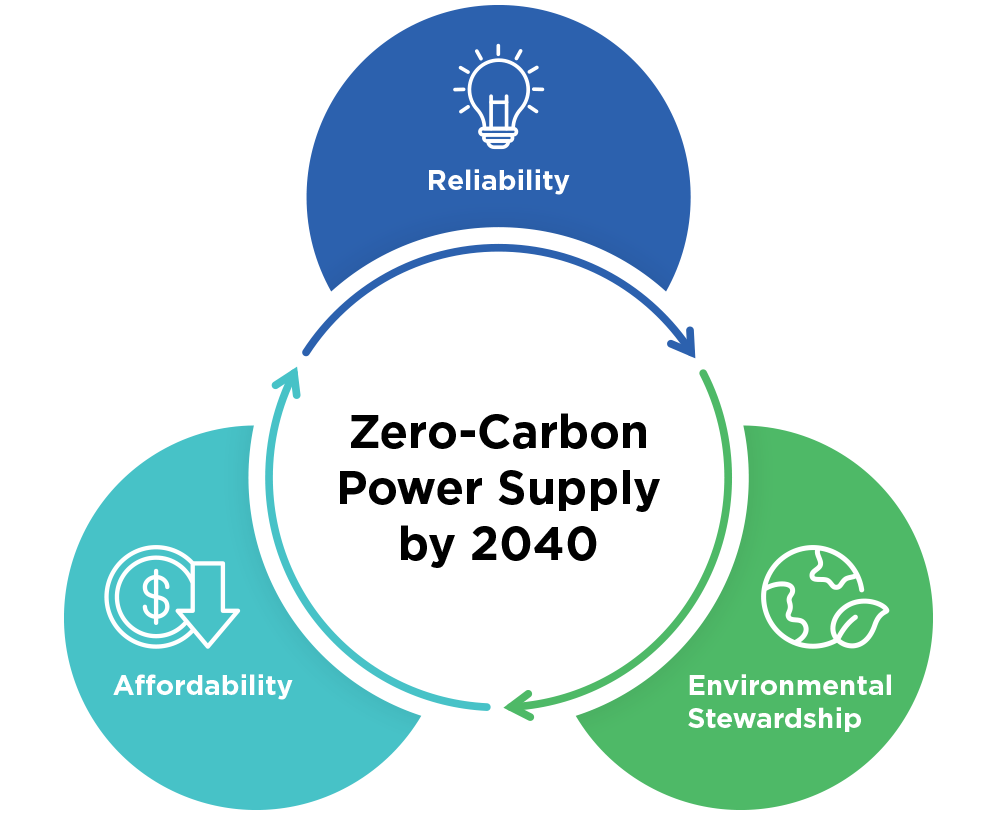
Reaching a 100% zero-carbon power supply by 2040 will require an approach that balances electric reliability, environmental stewardship, and affordability.
Renewable resources, such as solar, wind, and hydropower are important, but they are not the only tools needed to achieve a zero-carbon future.
BWP is exploring and investing in a variety of technologies and strategies that support a reliable zero-carbon power supply, including:
- Energy storage technologies that help deliver power when renewable resources are not available
- Grid modernization and infrastructure improvements
- Energy efficiency and conservation programs
- Regional power market participation and clean energy purchases
- Emerging zero-carbon technologies as they become commercially available
By combining multiple solutions, BWP can continue working toward a zero-carbon energy future while balancing electric reliability, environmental stewardship, and affordability for the community.
Renewable resources, such as solar, wind, and hydropower are important, but they are not the only tools needed to achieve a zero-carbon future.
BWP is exploring and investing in a variety of technologies and strategies that support a reliable zero-carbon power supply, including:
- Energy storage technologies that help deliver power when renewable resources are not available
- Grid modernization and infrastructure improvements
- Energy efficiency and conservation programs
- Regional power market participation and clean energy purchases
- Emerging zero-carbon technologies as they become commercially available
By combining multiple solutions, BWP can continue working toward a zero-carbon energy future while balancing electric reliability, environmental stewardship, and affordability for the community.
- Energy storage technologies that help deliver power when renewable resources are not available
- Grid modernization and infrastructure improvements
- Energy efficiency and conservation programs
- Regional power market participation and clean energy purchases
- Emerging zero-carbon technologies as they become commercially available
By combining multiple solutions, BWP can continue working toward a zero-carbon energy future while balancing electric reliability, environmental stewardship, and affordability for the community.
About the Power Content Label
The Power Content Label is an annual disclosure required by the State of California that provides customers with information about the sources of electricity delivered by their utility (BWP). The label shows the percentage of electricity generated from different energy sources, including renewable resources, natural gas, large hydroelectric facilities, and other energy sources. It also provides information about greenhouse gas emissions associated with the utility’s power supply.
The Power Content Label helps customers better understand how their electricity is generated and how utilities are progressing toward clean energy and climate goals.
| 2025 POWER CONTENT LABEL | |||
|---|---|---|---|
| Burbank Water and Power | |||
| Emissions, Power Sources, and Unbundled RECs | Burbank Water and Power (Retail Sales) | Burbank Water and Power Total (Retail Sales, Other End Uses, & Losses) | CA Utility Average (Retail Sales, Other End Uses, & Losses) |
| Greenhouse Gas Emissions Intensity (lbs of CO2e emitted per megawatt hour) |
692 | 711 | 384 |
| Renewables and Zero-Carbon Resources Fossil Fuels |
40% 60% |
38% 62% |
67% 33% |
| Biomass & Biogas | 2% | 2% | 2% |
| Geothermal | 2% | 2% | 5% |
| Eligible Hydroelectric | 1% | 1% | 1% |
| Solar | 17% | 16% | 25% |
| Wind | 7% | 7% | 14% |
| RPS Eligible Renewables - Subtotal | 29% | 27% | 46% |
| Large Hydroelectric | 2% | 2% | 10% |
| Nuclear | 9% | 8% | 10% |
| Emerging Technologies | 0% | 0% | 0% |
| Other | 0% | 0% | 0% |
| Natural Gas | 47% | 44% | 11% |
| Coal & Petroleum | 11% | 10% | 2% |
| Unspecified Power (92% fossil fuels) | 3% | 8% | 21% |
| Total | 100% | 100% | 100% |
| Retail sales covered by retired unbundled RECs | 4% | N/A | N/A |
| ■ This label does not reflect compliance with the Renewables Portfolio Standard (RPS), which measures the use of tracking instruments called Renewable Energy Credits (RECs) over the course of multi-year compliance periods. RECs that are purchased separately from the renewable energy ("Unbundled RECs") can be used for RPS compliance, but they do not factor into the power mixes or GHG emissions intensities above ■ GHG intensity figures exclude biogenic CO2 and emissions from geothermal sources and grandfathered imports of firmed-and-shaped energy. For detailed information about all GHG emissions from California's retail electricity suppliers, visit the CEC webpage at the link below. ■ Unspecified power is electricity purchased from a genericized pool on the open market. In 2025, 92% of unspecified power came from fossil fuels (natural gas, coal, and petroleum) and 8% came from renewables and zero-carbon resources (RPS-eligible and other renewables, large hydroelectric, and nuclear). |
|||
| Burbank Water and Power https://www.burbankwaterandpower.com/power-content-information |
California Energy Commission - Power Source Disclosure https://www.energy.ca.gov/programs-and-topics/programs/power-source-disclosure-program/power-content-label |
||
Stay Connected
