


Frequently Asked Questions About the Commercial EV Charger Rebate Program
Have a question? We're here to help! Find answers to our frequently asked questions about the Commercial EV Charger Rebate Program
The Commercial EV Charging Station Rebate Program provides rebates to BWP commercial customers to offset some of the costs of purchasing and installing qualified EV charging stations, including Level 2 charging stations and DC fast chargers. Level 1 charging stations deployed in common areas of multi-family residences may also qualify for a rebate.
You have two options to apply for a rebate, using the application available at here.
- Before deployment of the charging stations: Rebate Reservation
If you have completed planning of your EV charging deployment and have applied for permits, you may apply for a rebate reservation. If approved, the rebate reservation will secure funding for your rebate, even if we have to waitlist applications or suspend enrollment. Please note that payment of the rebate is not guaranteed unless and until you complete deployment in accordance with the program’s terms and conditions.
- After deployment of the charging stations: Rebate Payment
If you already have completed the deployment of the charging stations and have passed inspection, you may apply for a rebate and submit the required documents showing that the deployment meets the program’s requirements. Your application must be submitted no later than six months following the issuance date of “finaled” permits by the City of Burbank for the installation of qualifying charging stations (i.e., after your site passes inspection).
- If you request a rebate reservation
Before applying for a rebate reservation, you will need to plan your deployment, including identifying the charging level, number, and location of the charging stations you want to deploy at your site.
Your site must be evaluated by a licensed electrical contractor or engineer to determine if your current electrical panel has capacity to serve the electric load needed by the new charging stations. If you need a panel upgrade or a new panel, you will also need to reach out to BWP’s Service Planning (818) 238-3565 to determine if the BWP utility infrastructure serving your site has capacity.
You will then have to apply for the necessary permits with the City of Burbank. At this point, you should have all required documents to apply for a rebate reservation.
- If you apply for a rebate payment
You will need to complete deployment of EV charging stations, including passing inspection with Burbank’s Building & Safety Division, and submit the required documents in accordance with the program’s terms and conditions.
Qualifying charging stations must:
- Be purchased new and unused
- Be certified and listed by a nationally recognized testing laboratory (NRTL) as identified by the US Occupational Safety and Health Administration (e.g., Underwriters Laboratories or UL)
- Have network/Wi-Fi capability and be addressable by an EV charging network participating in the program (i.e., qualifying charging stations must be connected to the EV charging network at all times).
- Meet either of the following technical requirements:
- Level 1 charging stations are only eligible in common areas of multi-family residences and must support the SAE International J1772 standard with a minimum output power of 1.4 kW,
- Level 2 charging stations must support the SAE International J1772 standard with a minimum output power of 3.3 kW, or
- DC fast chargers (DCFCs) must have a minimum output power of 50 kW per connector. Each premises, as defined below, must have DCFCs rebated under the program that can support at least two of the following three fast charging connector types: CHAdeMO, SAE CCS, and/or Tesla. No more than two-thirds of all qualifying DCFCs deployed at a premises and rebated under the program may support a single fast charging connector type.
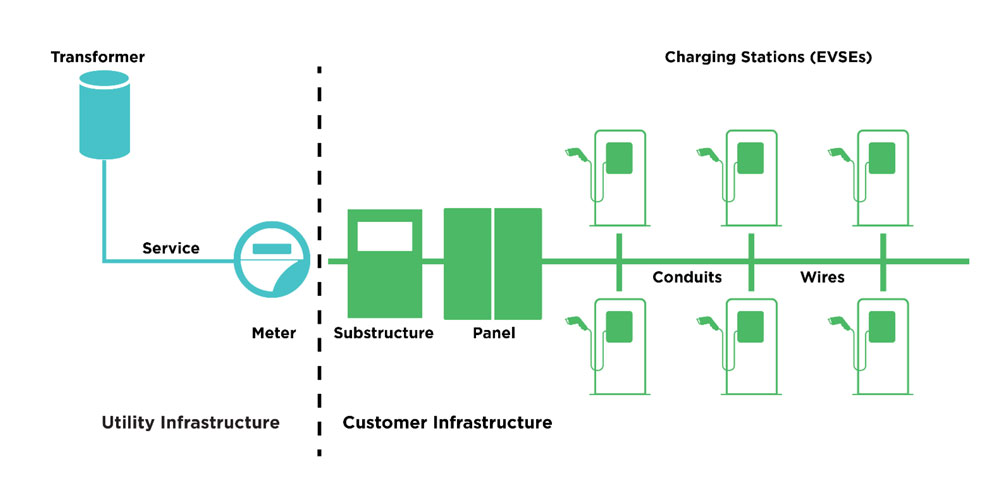
Eligible installation costs are limited to hardware and labor costs in connection with the deployment of panels, circuit breakers and meter sockets, electrical conduits, wiring, junction boxes, disconnects, switches, and fuses, together with trenching, resurfacing, and connecting qualifying charging stations. Eligible installation costs also include any costs billed by BWP to customers to deploy electric utility infrastructure that may be required to serve qualifying charging stations.
However, please note that costs incurred for the purchase and installation of charging stations, electrical conduits, and panels required by the Burbank Building Code are not eligible cost under the program. Similarly, charging station operation and maintenance costs (e.g., extended warranties, servicing contracts, EV charging network fees) are not eligible costs under the program either.
Applications (rebate reservation or rebate payment requests) are accepted on a first-come, first-served basis and processed in the order received. Funds are limited and rebates are not guaranteed. BWP may waitlist applications if funding is anticipated to become insufficient. BWP may also suspend program enrollment and stop accepting applications until additional funding is available.
Third-party financial incentives, like BWP’s program, offset some of the actual costs of deploying charging stations. BWP’s program should not generate a windfall for customers.
Stay Connected
